Stripe's stablecoin blockchain Tempo launches public testnet

cointelegraphPubblicato 2025-12-10Pubblicato ultima volta 2025-12-10

Introduzione

Stripe and Paradigm's blockchain project Tempo has launched its public testnet, a key milestone toward its official layer-1 blockchain release. The open-source testnet allows users to run nodes and test features like dedicated payment lanes, stablecoin-native gas, a built-in decentralized exchange, and fast deterministic finality. Tempo is designed for instant settlement, low fees, and a stablecoin-native experience tailored for financial applications. Users can create stablecoins directly from their browser using Tempo’s TIP-20 token standard. The project, which raised $500 million at a $5 billion valuation three months ago, has added major design partners including Mastercard, UBS, and Klarna, which recently launched a USD-pegged stablecoin on the network.

Stripe and Paradigm’s joint blockchain project Tempo has launched its first public testnet, marking a major step forward to launching the official layer-1 blockchain.

According to a Tuesday announcement from Tempo, the open source testnet is now live with anyone being able to “run a node or sync the chain” and test out a range of features.

“Today's testnet launch kicks off the next phase of Tempo's development, with a focus on scale, reliability, and integration experience. Over the coming months, we'll continue onboarding new infrastructure partners, adding new features and developer tooling, and stress-testing throughput under real payment loads,” Tempo said.
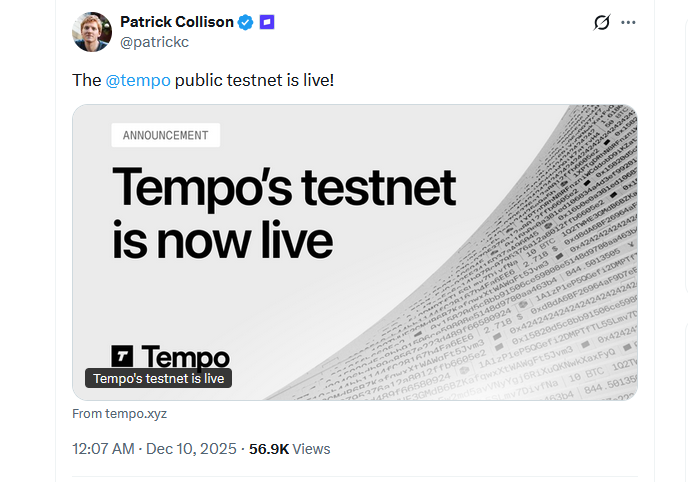
Source: Patrick Collison

The announcement highlighted six key features live on the network. These include: dedicated payment lanes, stablecoin-native gas, built-in stable asset decentralized exchange, payments and transfers metadata, fast deterministic finality and modern wallet signing methods.

“Tempo is built to deliver instant, deterministic settlement, predictably low fees, and a stablecoin-native experience, which are qualities that most general-purpose blockchains still struggle to provide for financial applications,” Tempo said.

Related: Blockchain trial on Canton Network tests collateral reuse with tokenized US Treasurys

In an X post following the launch, Paradigm general partner and chief technology officer Georgios Konstantopoulos highlighted a feature that enables Tempo testnet users to create stablecoins directly from their browsers.

Stablecoins created on the network will be built via Tempo’s TIP-20 token standard. However, the specific liquidity and collateral requirements for when the actual blockchain launches are not explicitly listed in the testnet docs.
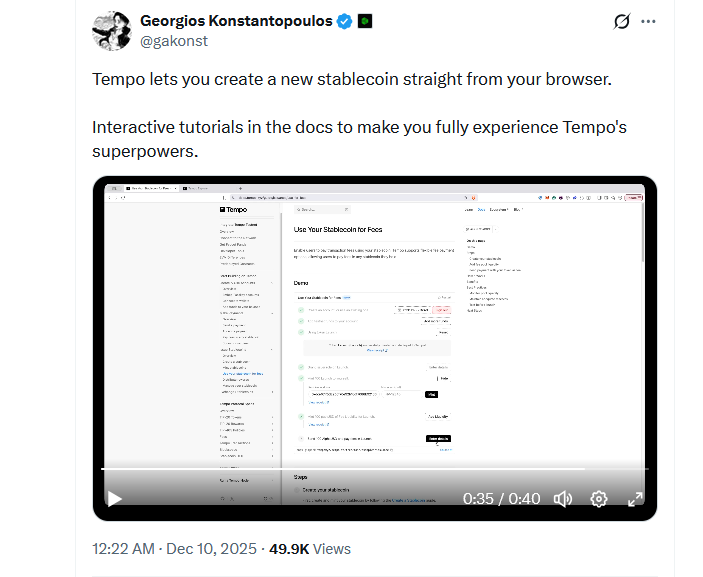
Source: Georgios Konstantopoulos

Tempo shows strong momentum as design partners grow

The testnet arrives four months after Stripe and Paradigm initially unveiled Tempo, and three months after it raised $500 million at a $5 billion valuation. The project kicked things off with heavy hitter design partners such as OpenAI, Deutsche Bank, Standard Chartered and Shopify.

In the latest announcement, Tempo emphasized that it has since signed on a host of new design partners, including big names such as Mastercard, UBS, Kalshi and Klarna.

Late last month, Klarna, the EU-licensed buy-now-pay-later firm, rolled out a USD-pegged stablecoin on Tempo, becoming the first digital bank on the network to do so.

Magazine: 13 Christmas gifts that Bitcoin and crypto degens will love

Letture associate

Interop Roadmap Accelerates: After Fusaka Upgrade, Ethereum Interoperability May Take a Key Leap

Recent Ethereum Fusaka upgrade, while primarily focused on Blob capacity expansion, introduced the underappreciated EIP-7825, a critical enabler for Ethereum's zero-knowledge (ZK) and interoperability roadmap. This proposal sets a hard per-transaction gas limit (~16.78 million gas), preventing "mega-transactions" from monopolizing a block. This change transforms block proof generation from a sequential logic problem into a parallelizable computational task, making real-time ZK proofs an engineering feasibility rather than a theoretical impossibility. This foundational shift is pivotal for the L1 zkEVM vision, where Ethereum itself generates verifiable proofs for its state transitions. L1 zkEVM acts as a universal "trust anchor," allowing Layer 2s (L2s) to instantly and trustlessly verify the mainnet's state without waiting for challenge periods. This eliminates the speed-trust decentralization trade-off, enabling near-instant, decentralized cross-chain interoperability. Concurrently, ZK technology is evolving from EVM-compatible zkEVMs to more efficient, ZK-optimized zkVMs. EIP-7825's parallelizable environment allows these zkVMs to operate at peak efficiency, drastically reducing proof generation cost and time. The convergence of EIP-7825, L1 zkEVM, and advanced zkVMs paves the way for the final stage of interoperability (Interop)—abstracting away chain boundaries to deliver a single-chain user experience where cross-chain actions are seamless, secure, and instantaneous.

marsbit16 min fa

Interop Roadmap Accelerates: After Fusaka Upgrade, Ethereum Interoperability May Take a Key Leap

marsbit16 min fa

Trading

Spot
Futures
活动图片